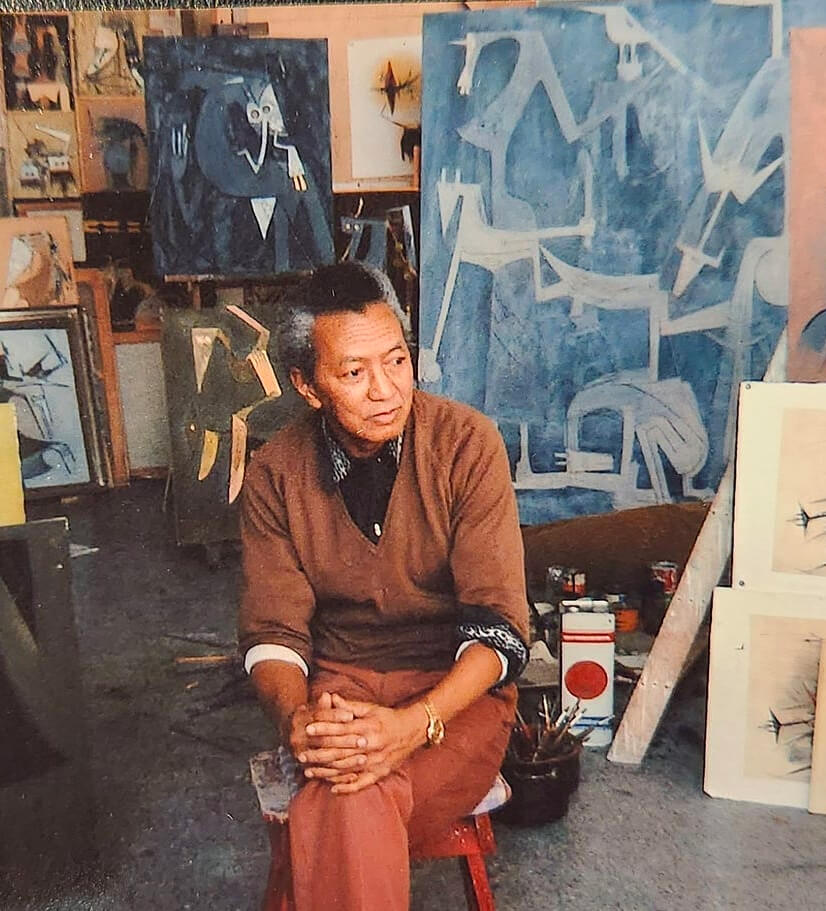
“My art is an act of decolonisation.”
Wifredo Lam was born in 1902 in Sagua La Grande, Cuba. Son of a Chinese father and a mother of Afro-Spanish descent, Wilfredo (who would change the spelling of his name to Wifredo in 1924) developed a strong inclination towards drawing from an early age. This led him first to study the great European masters—Leonardo da Vinci, Goya, Velázquez and Delacroix—and subsequently to enroll in the Escuela Profesional de Pintura y Escultura, Academia de San Alejandroin Havana.
In 1923, after holding his first solo exhibition in Havana, he won a scholarship that enabled him to travel to Europe. At twenty-one he moved to Madrid, where he attended the Escuela Libre de Paisaje and came into contact with the ideas and movements of modern art. These encounters prompted him to reflect on the connections between Western art and what was then labelled “primitive” art—a constellation of images, gestures and forms familiar to him since childhood. During this period, he was in search of his own style, mainly dedicating himself to portraits and landscapes, integrating into Madrid’s cultural milieu and exhibiting in local galleries.
In 1938 he decided to leave for Paris, where he met Picasso. Despite coming from different artistic backgrounds, the two had achieved similar formal outcomes, which fostered a profound affinity between them and secured Lam’s acceptance into the Parisian circles of painters, critics and poets. Here he also met André Breton and the Surrealist movement. A few years after his arrival in France, his first solo show was held at Galerie Pierre, followed by a group exhibition with Picasso at the Perls Gallery in New York.
With the outbreak of the Second World War, Lam was forced to return to Cuba after eighteen years away. This marked the beginning of an extraordinarily fertile phase in his work, characterised by an in-depth exploration of Afro-Cuban culture and its rituals, informed by family stories and his own childhood memories. Rediscovering his roots led him to reinvent his pictorial practice, forging an imagery that subtracted itself “from the dream of exoticism that plagued Western painting” by merging elements of European avant-gardes (Cubism and Surrealism) with Afro-Cuban art.
From 1942 onwards he exhibited regularly at the Pierre Matisse Gallery in New York, and throughout the 1940s and 50s his works were featured in major group shows at the Institute of Modern Art in Boston, the MoMA in New York, and the Liljevalchs Konsthall in Stockholm. These were followed by his participation in the Salon de Mai (from 1954 to 1982), Documenta II in Kassel (1959) and the Venice Biennale (1972).
From the 1950s Lam was invited to the Incontri Internazionali di Scultura e Ceramica in Albisola Marina, where he came into contact with artists of the Movimento Nucleare and with international collectors, among them Giovanni and Anna Pia Mazzoleni. These encounters led him to begin working with ceramics, simplifying his style to adapt it to the technical demands of the medium.
In the 1960s he held numerous solo exhibitions across the Americas, Italy and France, and in 1964 he was awarded the Guggenheim International Award.
In the 1970s his work was characterised by a return to vibrant colours and by his experimentation with terracotta, showcased for the first time in 1975 at the Museo della Ceramica in Albisola. Several monographs, were published in different languages during these years, celebrating both his international reputation and a career which came to a close with his death in Paris in 1982.
Recognised today as both a pioneering figure of modernism and as a forerunner of contemporary decolonial thought, his works are held in collections worldwide. These include the Museum of Modern Art (MoMA) and the Guggenheim Museum in New York, the Tate Modern in London, the Centre Pompidou in Paris, the Museo Nacional Centro de Arte Reina Sofía in Madrid, and the Wifredo Lam Contemporary Art Center in Havana. In Italy, his works are part of the permanent collections of several major institutions, including the Museo della Ceramica in Savona, the MuDA in Albisola Marina and the Museo del Novecento in Milan.
Source: Luciano Caprile (ed.), Wifredo Lam. Cuba Italia. Un percorso, Silvana Ed., Cinisello Balsamo, 2002
Website: wifredolam.org